
Your Soil Evaluation Came Back Bad. That Isn’t Always the Final Answer.
If you just got a soil evaluation back and the numbers were poor, or someone told you the lot “failed,” there is usually one more move to make before you accept that answer. It’s called wet season monitoring. It doesn’t cost much, happens between January and April, and has turned unbuildable lots into buildable ones and very expensive septic designs into manageable ones.
Here’s how it works and when it’s worth doing:
What the soil evaluation actually tells you
The number that controls everything on a septic design is the seasonal high groundwater table, or SHGWT. It determines how deep the system can go, how much fill you need, whether you need advanced treatment, and sometimes whether you can build at all.

In a standard soil evaluation, that number isn’t measured. It’s interpreted. A licensed soil evaluator digs test holes and reads the colors and staining in the soil, called redox features, to judge how high water has historically risen. It’s an established method and it’s the right first step. But it’s a reading of the soil’s history, not a reading of today’s water.
We recently tested a site where both holes went down to nine feet and came back with seasonal high water tables of four inches and eleven inches. In Rhode Island, you need at least twelve inches to even file a variance application. Anything under that is an automatic denial. On paper, that lot was finished.
Why we don’t stop there in glacial till
A lot of Rhode Island sits on glacial till, and till is the hardest soil in the state to read.
Dense till perches water. Rain comes down, hits the tight layer, sits on top of it for a few days, then drains away sideways. That perched water leaves the same staining in the soil that a true groundwater table leaves. The soil looks wet. The actual water table may be several feet lower.

On top of that, much of our till came from dark bedrock, so the soil is already low in color before any water ever touched it, and the staining there can be a record of conditions from decades ago rather than conditions today.
A soil evaluator has to interpret conservatively. That’s the correct professional posture. The result is that in these soils, the reported water table is often higher than where water actually stands in the wettest part of the year.
Wet season monitoring: going out and measuring it
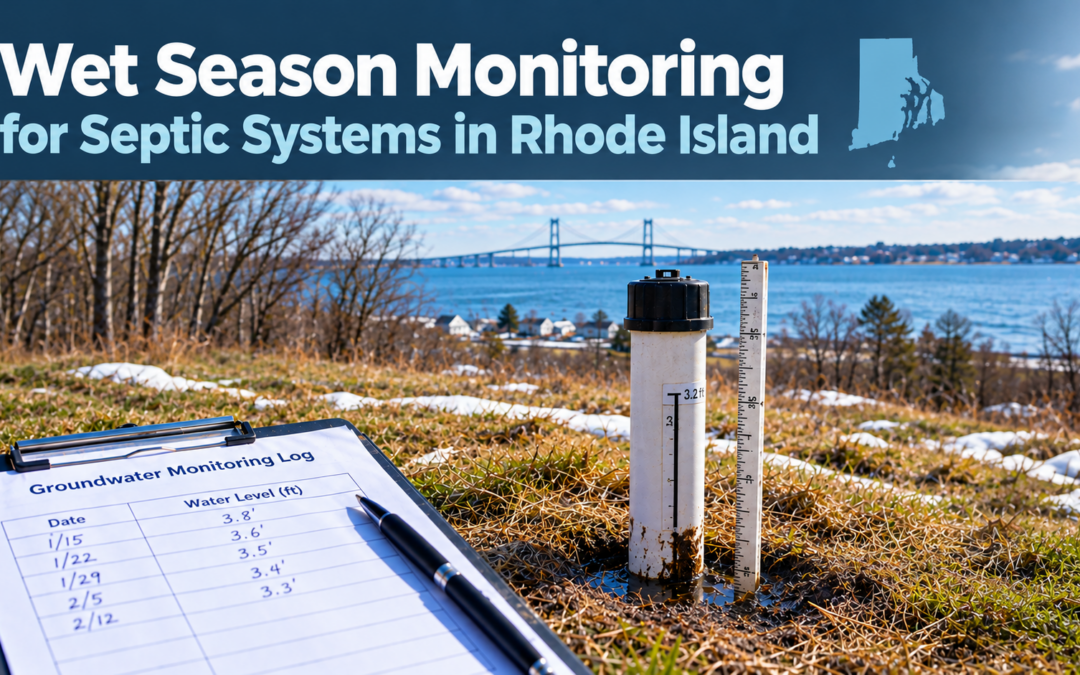
RIDEM allows you to settle the question by measurement instead of interpretation. The wet season runs from January 1 to April 1, and a licensed designer or soil evaluator installs test pipes and takes readings of the actual water level over that period. In practice, it’s about three weeks of readings on a set schedule. If those readings come back better than the soil evaluation, the water table used for your design gets adjusted to reflect them.
Take a look at this RIDEM fact sheet on wet season groundwater table monitoring.
We’ve been reading these soils for decades, and statistically we’ve had good luck improving results in glacial till. Not every site improves, and we’ll tell you honestly when we think the odds are poor. But when a site does improve, the difference is rarely small. It can mean a conventional system instead of advanced treatment with a lifetime maintenance contract. It can mean far less imported fill, a lower system and a yard that still looks like a yard. On a marginal lot, it can be the difference between a house and no house.
The catch is the calendar
The window for monitoring is January through April, once a year. Test pipes need to be in the ground before then. If you wait until spring to start asking about it, you’ve lost a full building season without realizing it.
So if your soil evaluation came back short, the next step is simple: get on the wet season monitoring list now, and we’ll schedule the work as soon as January arrives.
We’d rather spend a few winter mornings finding out what the water is really doing than have you design around a number that may be inaccurate.
NEI has decades of experience dealing with soil evaluations, wet season monitoring and septic designs. Feel free to call us for more information on your specific project.